
I’m excited to announce the launch of USOWN Scout, a fully searchable database of advanced analytics to track IndyCar prospects who have competed in the USF Pro Championships from 2015-2025.
USOWN Scout is available now in full at usownscoutdeck.com.
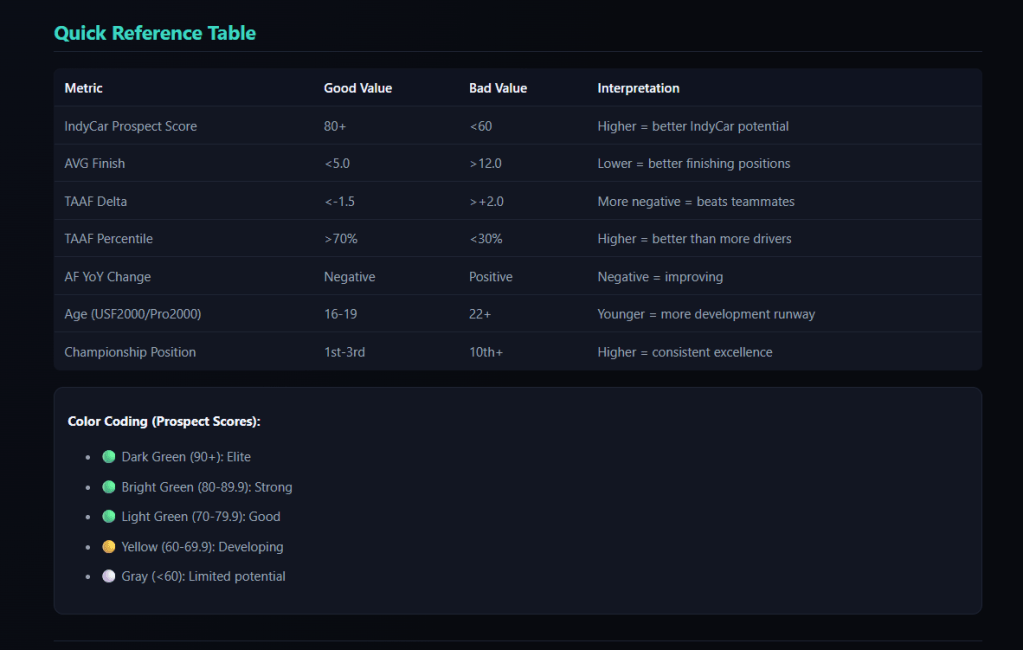
USOWN Scout’s full explanation of every metric that appears on a driver’s page and methodological considerations are available here.
Some quick notes:
- Drivers who have only completed a full season in USF Juniors will naturally have lower prospect scores until they complete at least 10 races in either USF2000 or USF Pro 2000. This is to adjust for the gap between USF Juniors and USF2000. (drivers who jump likely finish 1.83 average positions per race lower in their first season of USF2000 compared to their final season of USF Juniors)
- For USF Juniors drivers, a promising prospect score is more so in the 40-70 range. Their prospect scores are likely to rise as they rise through the ranks.
- To avoid outliers and make sure the formulas can be simplified, seasons where drivers completed less than nine races are not included in calculations. Partial seasons are still included in the backend calculations so their full-time teammates can be compared to them.
USOWN Scout’s main idea is adjusting the average finish of a driver to a grand scheme of factors, including team performance, field strength, and the driver’s age. The end goal is IndyCar prospect score, a 0-100 metric which evaluates a driver’s likelihood for success at the next level.
Among drivers who do not reach IndyCar, the mean prospect score is 40.6. Drivers who reach IndyCar have a mean prospect score of 78.6, despite being brought down by a few outliers.
No driver who has driven in the USF Pro Championships from 2015-2025 and has had a prospect score lower than 86.1 has won a race, finished on the podium, or scored a pole in IndyCar. 60% of IndyCar graduates with >86 prospect scores have achieved at least one of those three benchmarks.
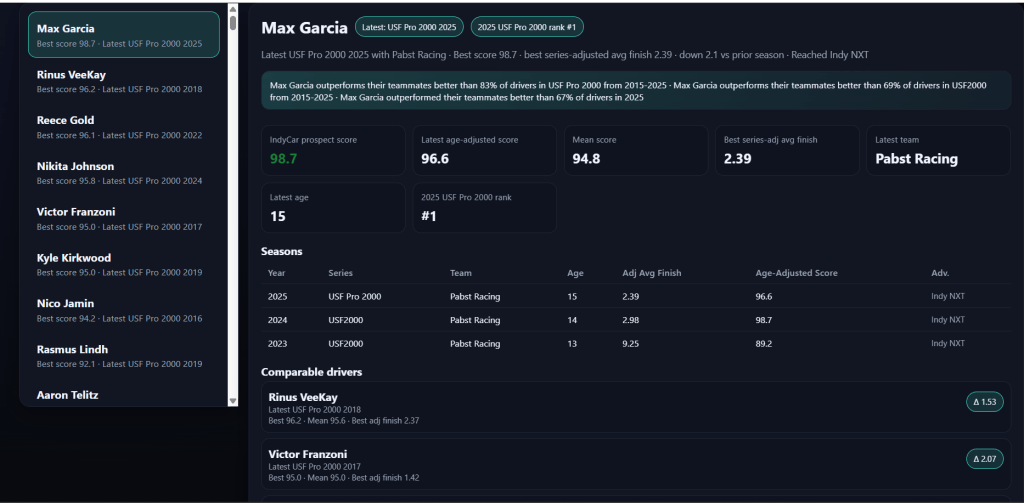
As you can see on this sample profile for Max Garcia, his average finish across his three seasons in the USF Pro Championships is adjusted for both the strength of the drivers he competed against and the strength of his equipment. Unsurprisingly, despite driving for the team champions in 2025 in USF Pro 2000, his adjusted average finish and prospect score is remarkably high.

Historical drivers are also included, in case you wished to check out how guys like Pato O’Ward, Kyle Kirkwood, and Louis Foster stack up compared to 2025’s USF Pro Championships drivers.
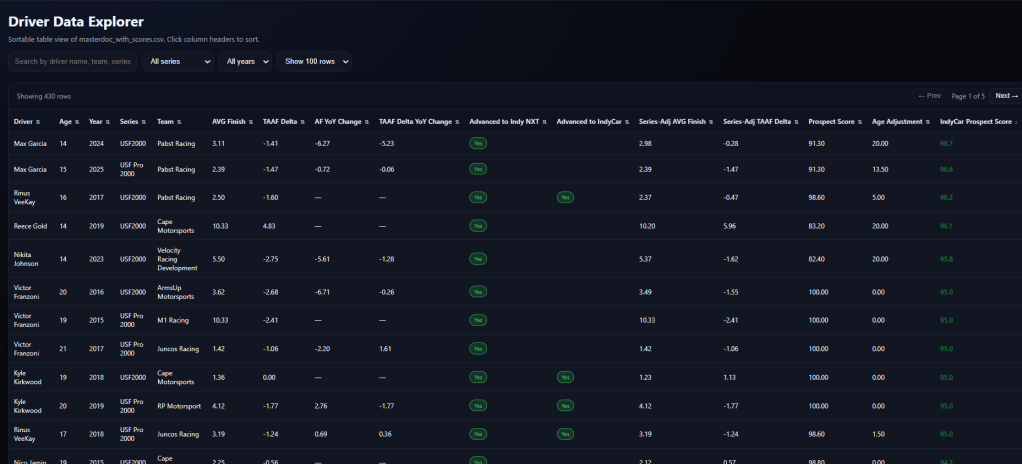
Additionally, Scout can be sorted into a table format to view backend statistics like the year over year changes for a given driver to their average finish or teammate-relative performance
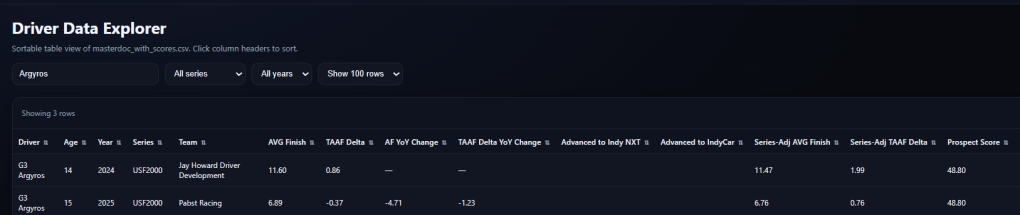
For example, searching Argyros allows for us not to just see G3 Argyros’s 2024 and 2025 stats, the YoY change categories allows us to see the changes in his stats from last season (-4.71 change to average finish from 2024.)
I could go on for hours about details, but a full explanation is on the statistics guide page of Scout’s website. And I hope that as opposed to myself explaining it, everyone who reads this chooses to play around with it!
My hope is that drivers who have been undervalued throughout their junior career can be viewed in a new light and be considered for greater opportunities. Additionally, I hope this allows for greater discourse and insight into what makes a good IndyCar (and motorsport) prospect. More to come from this project next year.
Thank you for all of your support. This is the last USOWN post of 2025, so, see you in year four of this website! Happy scouting!
 USOPENWHEELNATION
Leave a comment